


High-performance data analytics in Python, at scale.
Distributed
Multi-node data-parallel processing via optimized MPI communication.
Accelerated
Native, out-of-the-box, multi-GPU hardware acceleration via PyTorch.
Scalable
Scale effortlessly beyond single-node RAM limits.
Interoperable
Plug & play compatibility with the Python array ecosystem.
In a nutshell#
Heat builds on PyTorch and mpi4py to process massive arrays - huge collections of images, high-dimensional climate simulation grids, or massive machine learning feature matrices - that exceed the memory and computational limits of a single machine.
Define your data distribution axis via the split parameter, assign hardware using the device attribute, and let Heat orchestrate the parallel computation.
Prototype locally, execute on any cluster.
import heat as ht

# Distributed random matrix generation
A = ht.random.randn(40000, 10000, split=0, device="gpu")
B = ht.random.randn(10000, 40000, split=1, device="gpu")

# Multi-GPU-accelerated matrix multiplication
C = ht.matmul(A, B)
mpirun -np 4 python my_script.py
Getting started#
Quick Install
pip install heat
conda install -c conda-forge heat
HPC & multi-GPU deployments
For Spack, EasyBuild, and containerized setups, refer to our comprehensive deployment guide.
Latest news#
-
Jul 2026
New webpage launched
We overhauled our website, let us know what you think!
-
May 2026
Workshop registration open
Registration is open for our upcoming virtual workshop on high-performance data analytics. Join us for hands-on sessions, expert talks, and live demos of Heat in action.
-
April 2026
NumFOCUS Affiliation
Heat is officially a NumFOCUS affiliated project! A big milestone for our domain-agnostic library. Check out the announcement details.
-
March 2026
Version 1.8 Released
Our latest featured update is officially live. Check out the updated repository for full performance metrics.
-
October 2025
HeatHub ScienceServe Funding

Our project HeatHub has been awarded Helmholtz ScienceServe funding for 2026!
Tutorials & courses#

Run our tutorials on 
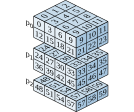
Download the full suite of interactive Jupyter notebooks to run on your own hardware or cluster.

A 30-minute welcome to Heat: DNDarrays and basic operations.
Parallel computing: distributed MPI computation and (multi-)GPU acceleration.
How-to guides#
Parallel I/O: ingest HDF5, Zarr, and NetCDF formats directly into distributed memory.
Clustering analysis: Automatically identify groups of similar data points in massive distributed datasets via unsupervised clustering methods.
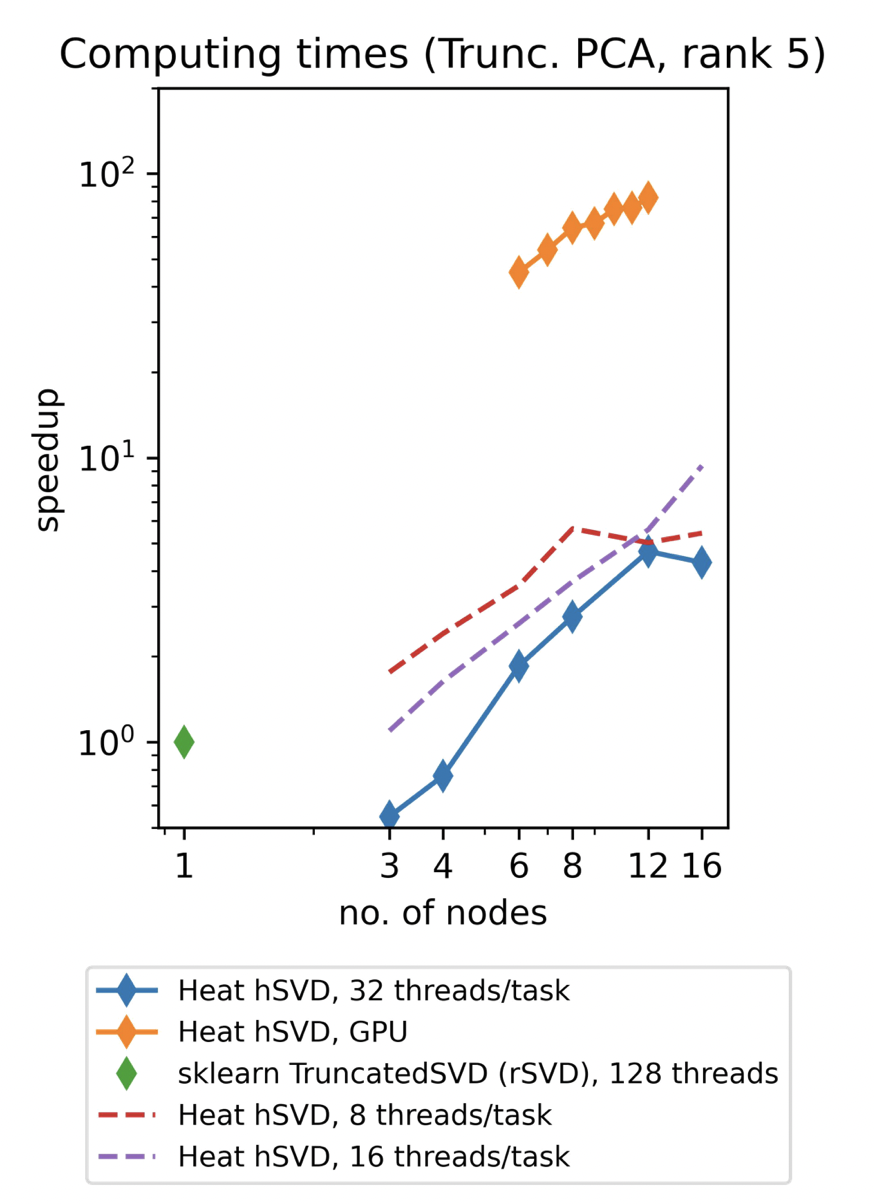
Linear algebra: Matrix-matrix multiplications, Singular Value Decomposition across multi-GPU.
Dimensionality reduction: Distributed clustering algorithms and Principal Component Analysis multi-node.

Profiling: Track cluster memory consumption, execution efficiency, and resource utilization using Perun.
Reference material#
Numerical data processing: NumPy/SciPy API compatibility tracking
API reference: all numerical functions and machine learning algorithms.